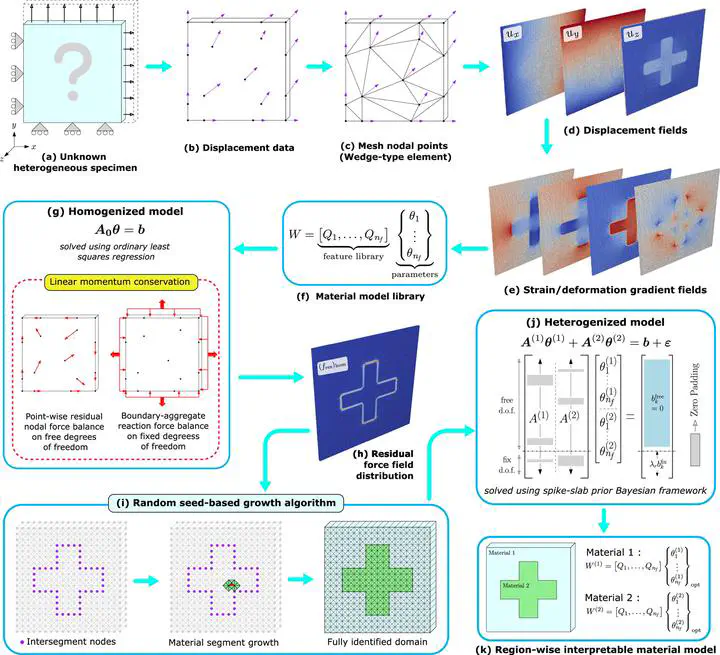
 Hetero-EUCLID workflow
Hetero-EUCLID segments a heterogeneous specimen into its material regions and discovers an interpretable hyperelastic model for each region, using only full-field displacements and boundary reaction forces, without stress data. It builds on Bayesian-EUCLID and works in two steps: residual force-based segmentation, then constitutive parameter identification with a sparsity-promoting spike-and-slab prior sampled by MCMC.
The repository includes example FE datasets (cross-shaped inclusion and split domain) for reproducing the results in the paper.
Quick start
git clone https://github.com/d3lab-iisc/Hetero-EUCLID.git
cd Hetero-EUCLID
pip install -r requirements.txt
cd drivers
python main_hss_hetero_euclid.py Type1_Cross_Shaped_Inclusion none
See the repository README for the conda environment, noise levels and output files.
Citation
If you use this code, please cite the paper:
K. L. Chaurasiya, S. Dutta, S. Kumar, A. Joshi. Hetero-EUCLID: Interpretable model discovery for heterogeneous hyperelastic materials using stress-unsupervised learning. Computer Methods in Applied Mechanics and Engineering, 452, 118729 (2026). doi:10.1016/j.cma.2026.118729
To cite the software itself, use the archived release on Zenodo: 10.5281/zenodo.23359467.